Clint Van Marrewijk
July 22, 2026
In the last two posts we shared how to compare lithium brine deposits, and a way to estimate what a lithium brine deposit is worth.
Let's now give you some detailed frameworks.
If you would rather quickly listen than read the below, last month we gave a speech at Fastmarkets on this topic:
Keynote at Fastmarkets, Las Vegas 2026, Zelandez.
Talk topics:
- What is a brine asset worth? Sixteen sample transactions, indicates a median of $69 a tonne of LCE in the ground.
- How big does an asset need to be? Roughly 2.5 million tonnes LCE is the rough rule-of-thumb for a standalone production candidate.
- What does "quality" actually mean? Eleven attributes, scored, then weighted to for the buyer.
- Why do good assets still fail? Many developers treat the PEA and the PFS as just milestones. In reality, that is where most of the value is won or lost.
- What is actually investable? We are often asked about lithium mines in Argentina, Chile and Bolivia. So we gave a quick take.
Let's now layout more detail for you.
Framework 1: Using past transactions
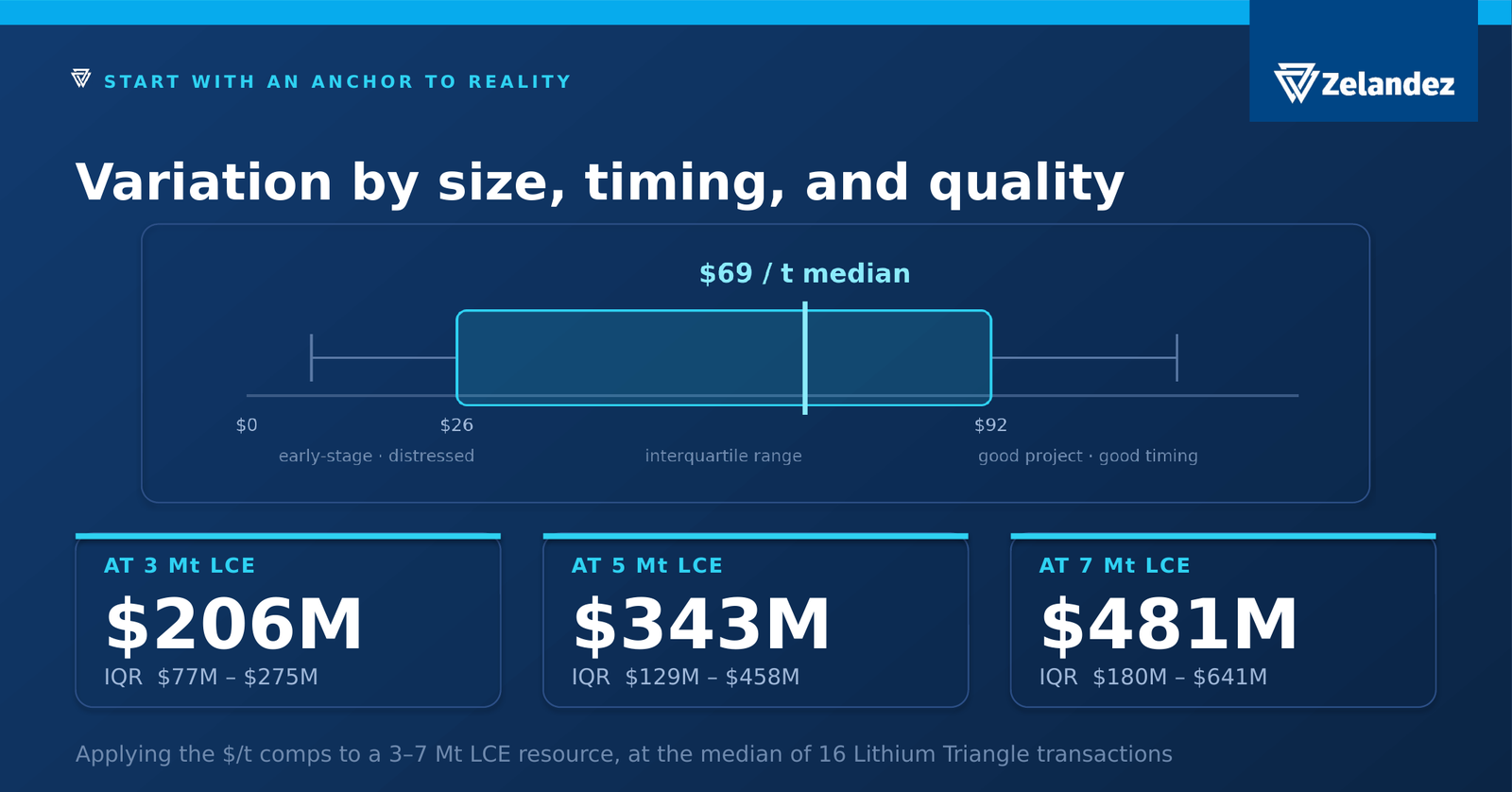
Above we display a case study of 16 transactions in Argentina, relative to the price paid for each tonne in the ground.
This is a very basic method of valuation. Nevertheless, we think that past transactions are a useful guide for pre-production lithium assets.
Our goal here is not to provide an exact number, but instead a framework. Something that is reasonable (and defensible) for brine mine owners to use.
Below are the actual transactions in the sample, so that you have them for yourself: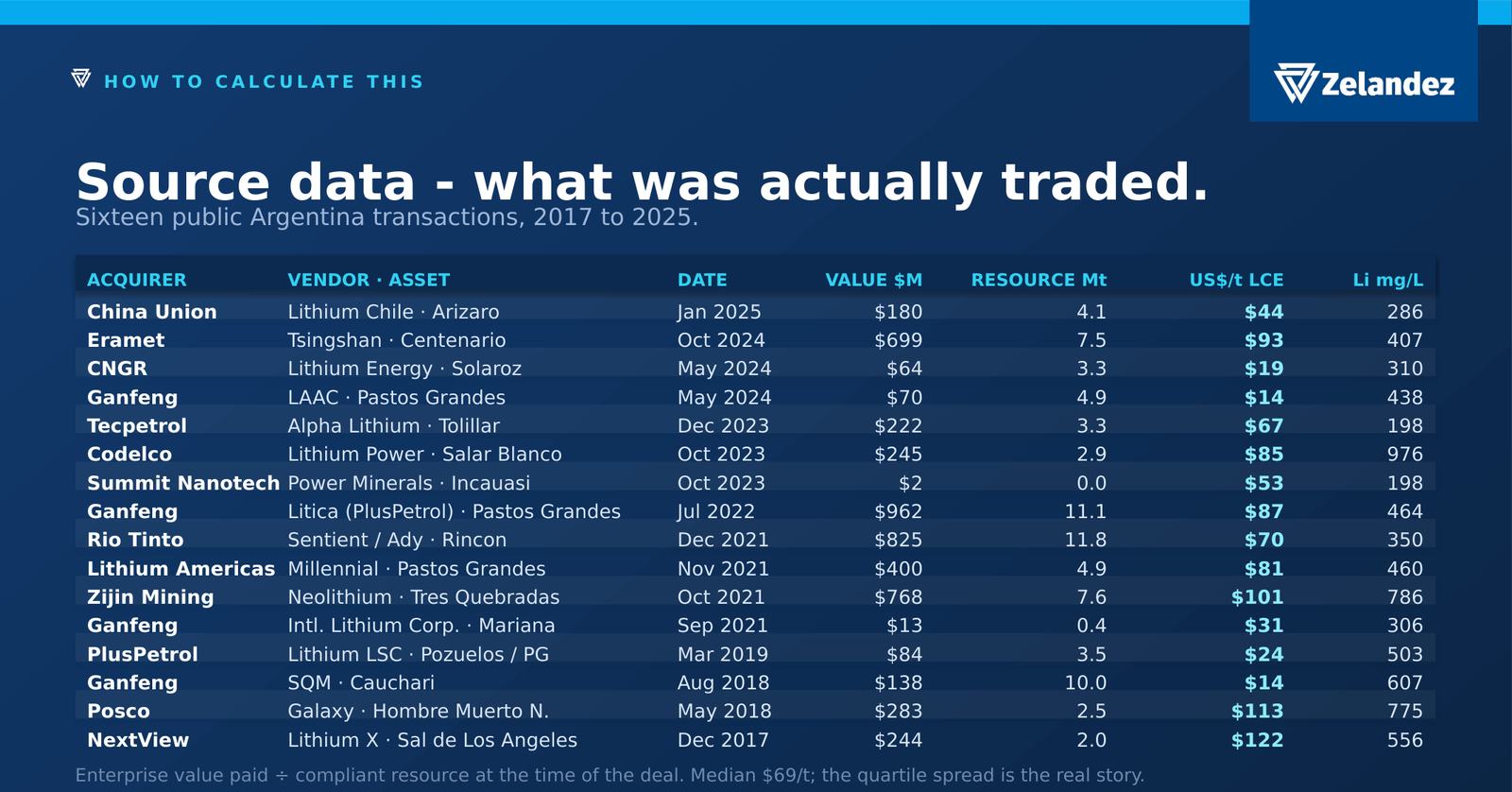
With this starting point, we can then compare each asset's attributes (see below), to understand where it should sit in the range.
Disclaimers: There are others ways that a lithium asset can be valued... However, clearly in our view, starting with past transactions should be a cornerstone. We've also used public data in this sample above, which as you may already know, is not always fulsome or completely accurate.
Framework 2: Size matters
There are hundreds of small land holdings on the large salt lakes of the world. Simply put, most of these small lithium projects are not worth much.
Primarily this is because certain costs of lithium mining do not scale down linearly. Obviously too, lithium brine is not hardrock... Brine moves. Rocks stay still.
So what is a small brine holding worth? A framework that helps make this concept real, can be borrowed from the oil and gas industry.
In oil and gas there is the concept of the Minimum Economic Field Size (MEFS). As an illustrative example for you, we show here our approximation of MEFS for lithium brine:
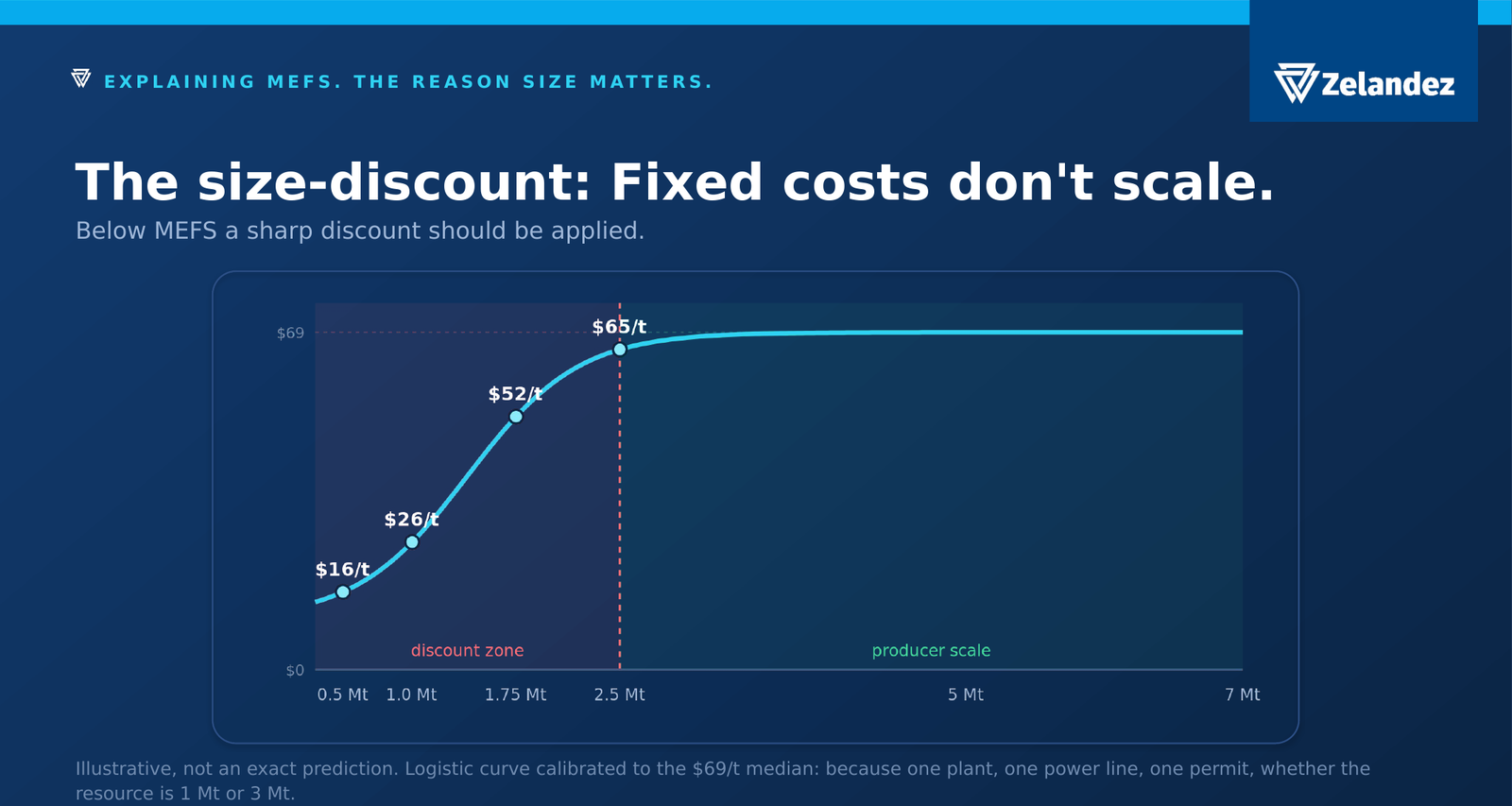
Note above how small assets display a much lower value per tonne in the ground.
At Zelandez, our internal rule-of-thumb is that a 2.5 Mt resource is needed, before a lithium brine asset can be credible as a "future standalone producer".
Below this size, and the fixed costs start to push hard against the credibility of the project.
Because when a project's resource is small, the likelihood it will ever be in the bottom half of the cost curve decreases. The likelihood it will survive a lithium price cycle, goes down... Way down.
Why do lithium miners obsess over the cost curve? To understand that, read the first post in this series.
So why does the MEFS framework matter? Because it helps to clarify the opportunity. Not just the risk.
Smart explorers already spend their time (and money) on assets that could be larger than their MEFS estimate. Unfortunately, many do not.
MEFS also makes clear why subsurface exploration is so important to do first. Because just discovering lithium, does not justify aboveground engineering expenses.
Finding enough lithium is what justifies aboveground expenses.
Framework 3: Weight by key attribute.
As we have previously mentioned, there are hundreds of lithium projects that are not yet in production (and these can be ranked).
However, it's not enough to simply rank each asset. Because in truth, not every lithium project is a good fit for every owner.
For example: a car company (with a consumer brand) should not own an asset close to protected wetlands. Or frankly, any project with a dubious social license to mine.
That's just one example. But suffice here to say, the weightings of each mine attribute below, are different for each potential owner. Here is how to weight the key attributes of lithium brine projects: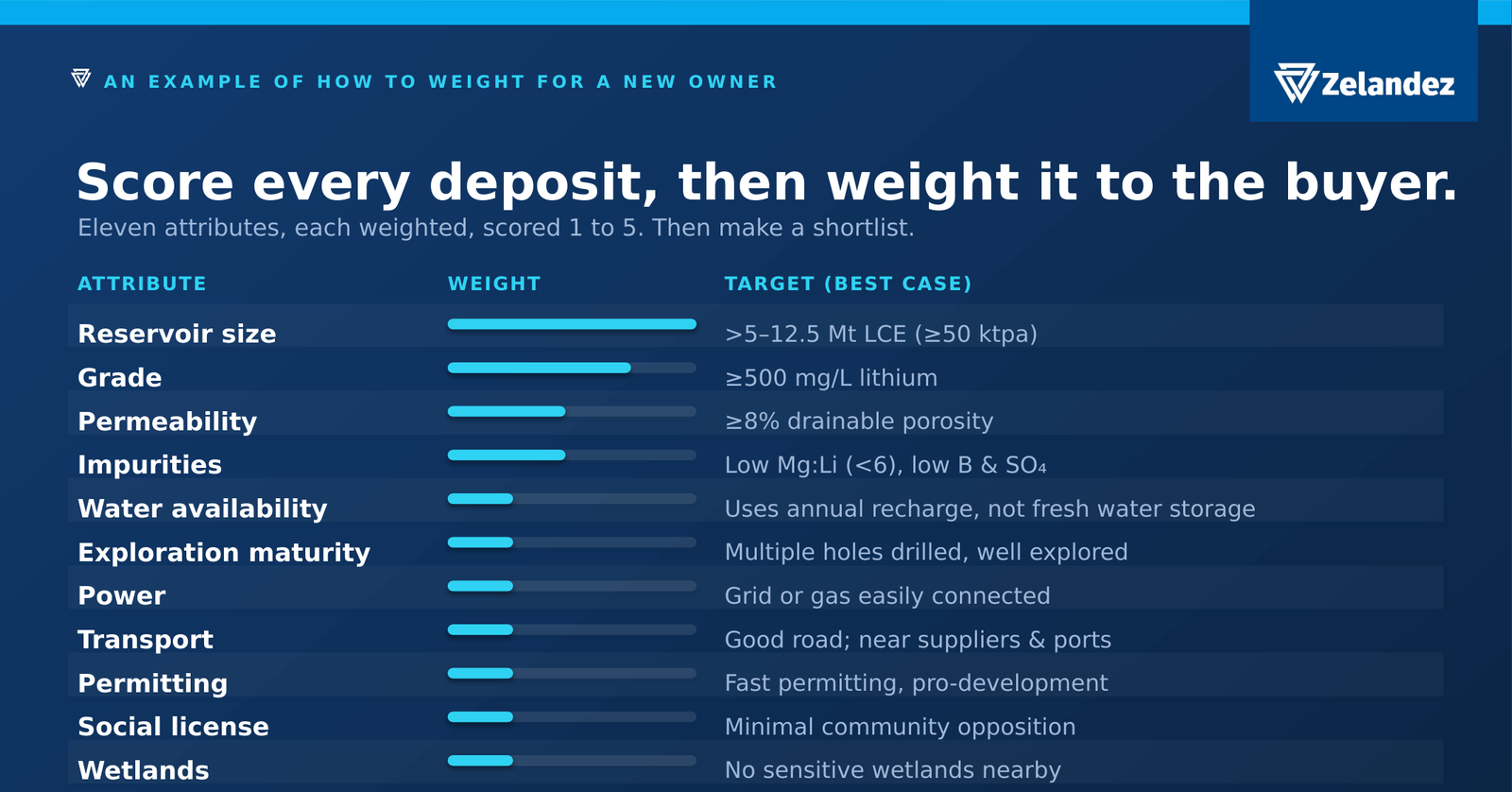
Now the rubber meets the road.
Once you have scored and weighted all the lithium assets in the world, you will then receive a global ranking that looks like this:
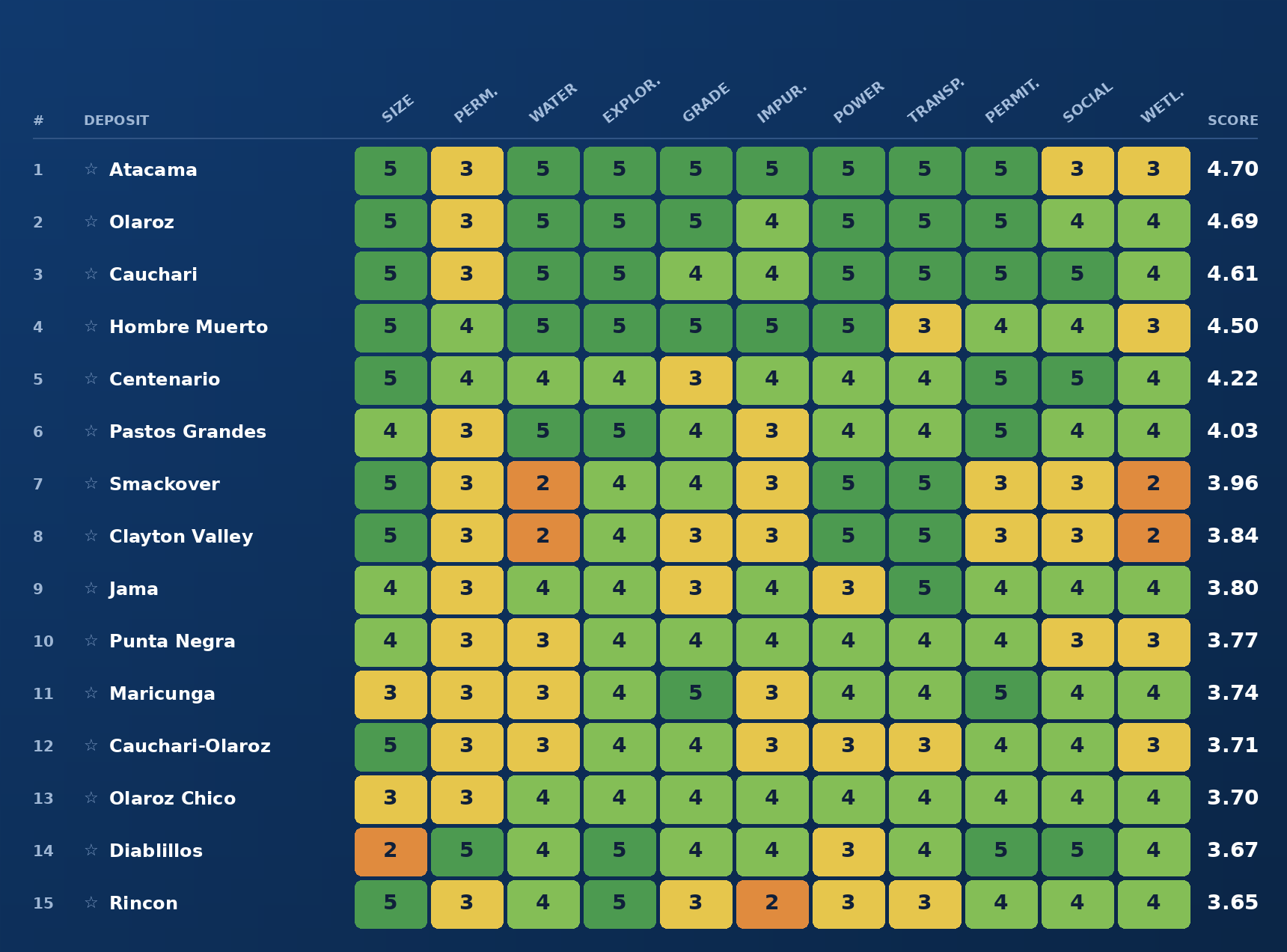
Above is an example at the deposit level (not the project level), showing just 15 of the world's lithium deposits.
As mentioned here, several times, each potential buyer will have a different global ranking.
From the seller's perspective too, this ranking system above, can be reverse engineered to help filter for ideal investor candidates. If you know what you're doing.
Hopefully these frameworks are useful for you.
We can now bring this three part series to a close.
- Part 1 is here: Lithium brine 101.
- Part 2 is here: How to value using past transactions.
- Part 3 (above)
Author: Clint Van Marrewijk
-- // --
About Zelandez: We strive to be aligned with the goals of brine miners. Zelandez is the leading provider of independent lithium brine services: hydrogeology, process engineering, full project managment, and project economic support. More information can be found here.
Recent Posts
What is a Lithium Brine Asset Worth?
Lithium Brine 101: How to compare and value lithium brine deposits
Using Digital Twin Technology in the Lithium Brine Industry
How the Inflation Reduction Act and US Trade Policy Could Handicap Its Ability to Harness Argentine Lithium Supply
The Lithium Brine Industry Must Share Reinjection Best Practices